My statement on responsibility and accountability in relation to Donau115, Summer 2023-2024

A few weeks ago, Julius Windisch shared the statement (text here) he made at Donau115 about their handling of the statement made by Friede Merz last July. This has prompted me to also share my own experiences with Donau115 since then whilst publicly expressing my own solidarity with Friede and challenging their structures. I have been holding onto and putting this off for months, mainly because I did not want to detract from Friede’s experience, but also because it seemed like many others were just getting on with stuff as though nothing has happened – Friede’s statement was a tidal wave for musicians in Berlin and in many other scenes, it deeply affected many people on many levels, but nothing seems to have changed structurally since then.

Before reading on, I encourage you to read Friede’s statement and Julius’ statement. I would also urge everyone to read the appendix to Friede’s statement which concerns Donau115, as it also demonstrates what I am about to talk about.

Many people reached out to me after I had publicly expressed criticisms of Donau115’s handling, both with their own experiences of abuse of power and expressing solidarity. I was glad that I could be there to listen, but angry and frustrated that because we exist in a small interconnected scene and because the existing structures are so broken, there was not much I could do about it other than try to engage with Donau115. In the almost one year since then, many musicians have also confided in me that they do not feel comfortable in this space anymore, and I know at least one other musician has faced a similar experience to my own, which demonstrates that this is a structural issue.

To be clear: the reason I am sharing this is not because I want any sympathy, because I miss the place or because I want more gigs – I no longer personally want to play at Donau115, though I will have to in the future due to the precarious financial situation I and many others are in. It’s because, also as an affected person, I want to make it known how hard it is to even express support for other affected people as a freelance musician without facing consequences that directly affect you socially and economically, and to show how much power then gets in the way for people who want to make a fairer and more ethical workplace and scene for themselves and others, and what people risk when they call something out. 

Like Julius, I would like to say that this is not an attack on Donau115. However, in a public institution/club/organisation etc. there needs to be responsibility and accountability from the top down, and when you cannot raise an issue with those in charge, the space is not a safer space, and further various abuses are facilitated.

My experience is as follows – I have used exact quotations where possible:

  • After expressing solidarity with Friede publicly, signing the statement that called for Donau115 to properly acknowledge their stance and make changes to make the space a safer space for affected people, I received a barrage of messages from one staff member in a position of power at Donau115 telling me that Friede Merz’s portrayal of the interactions between herself and Donau115 were ,,not portrayed properly’’ and that my posts (along with others) were going to destroy the club and make them lose their funding. Apparently I did not understand the ,,full story’’, but this staff member was unwilling to tell me what that supposedly was. This person told me that the owners see Donau115 as a ,,side thing’’ and that they’re ,,not that involved with anything’‘ – these attitudes are also reflected in Friede’s appendix statement.
  • The situation made it impossible for me to book anything at Donau115, and meant I was not welcome in the club. Essentially, I, as well as several other musicians in the scene, had been tacet cancelled. Around November 2023, I raised the issue I had with the staff member with an owner – I was offered a ,,workaround’’ to perform at the club by this owner, with no acknowledgement or response about said issue. This did not really feel comfortable but I decided to go ahead and complete the shows I had out of my sense of commitment to the projects performing and my own economic situation.
  • Several months later in March 2024, I raised the issue again with the same owner, since I had been promised a response by the owner at a later date, and even praised for being so open and transparent with them. I wanted to see if they were ok with a staff member (for whom they bear responsibility) cancelling musicians and also calling Friede’s account into question. I was disappointed that a place I had always viewed as welcoming and open, that had been a home to me and many others, could mess up so badly on so many levels, and I wanted to find some closure to the situation. 
  • The owner responded to me framing the issue as a ,,personal friction’’ between myself and the staff member, and refused to take any responsibility for the situation – they would not be my ,,conflict mediator’’. The owner told me they had ,,generally speaking… complete confidence’’ in this staff member. The owner refused to see the actions of their staff member on several musicians in Berlin, and their own actions towards me, as a structural issue, and said they do a lot of ,,unseen’’ and ,,unpaid’’ work ,,for the Berlin community’’. My own experience was essentially denied, and when I restated it, I was simply told the ,,workaround’’ was still possible and therefore there was no issue in me accessing the space. The owner placed a ,,boundary’’ and I was told I could no longer discuss this with them in any form.

In one of their posts made on 29.7.2023. about Friede’s statement, Donau115 said they were exploring ,,specific ways’’ to learn and that they would share them with the community when the work was done. They then closed the club without comment. Upon reopening, they said ,,We have begun a process of working with staff and external professionals to clarify the Donau115 GbR policy on similar cases in the future’’. As far as I am aware, and as Julius said in his statement, current staff at Donau115 are unaware of this happening at all, and there have been no further clarifications from Donau115 since last summer – I welcome a correction from Donau115 if I am wrong about this. Several ways for them to learn and develop are still open (awareness agencies, free funding to do do so etc.), as evidenced in Friede’s statement from July 2023 and Julius statement from a few weeks ago.

I would like to encourage Donau115 to make the attempt to begin making their space safer and clarifying their policy. To re-engage with people who hold them to account, not just ignore them and shut them down. There have been tens if not hundreds of examples of various forms of abuse of power in the music scene since Friede’s statement – I just heard another one about a different club yesterday. Musicians should not feel intimidated after supporting their colleagues or afraid of losing work, reputation, being labelled or attacked. I am not saying my experience is an abuse of power – I am saying that people in powerful positions make it difficult to impossible to speak out against such abuses.

I encourage those who attend the club as an audience or performers to think about whether they want to be a part of spaces that enable these kinds of situations with the musicians/bands they come to see or their colleagues. I ask those who attend/play in other clubs where they know of owners and staff who do not truly work for and with their communities and who enable or commit abuses of power, if they want to support that. In the absence of any unified codes of conduct, policies or structures, and with unions who are often separate from the actual working reality of musicians, the change has to happen from within the scene. I would like everyone to question their own ethics, to read and to empathise with others, to take things seriously. Support and believe affected people, read, learn, make mistakes, be a small part of building a community, a career, a space for everyone that can exist without other people being affected, gaslit, shamed, or shut down. 
New commissions through the GVL Scholarship

(Für diesen Beitrag in deutscher Sprache scrollen Sie bitte nach unten)

Press Release – English

I am very happy to announce 3 new commissions as part of my call for pieces project that started during the pandemic. Thanks to the GVL Scholarship, I am able to commission Yaz Lancaster, Nick Dunston and Jamie Elless to create 3 new solo pieces for double bass, which will be workshopped online, developed collaboratively and performed/recorded in Spring 2022. As the workshops will be held via video stream, please contact me to receive the link.

Below you can find out more about the composers:

Yaz Lancaster

Yaz Lancaster (they/them) is a Black transdisciplinary artist most interested in practices aligned with relational aesthetics and the everyday; fragments and collage; and liberatory politics. Yaz performs as a violinist, vocalist, and steel pannist in a wide variety of settings from DIY and popular music to orchestras; and their work is presented in many different mediums and collaborative projects. It often reckons with specific influences ranging from politics of identity and liberation, to natural phenomena and poetics. Yaz lives in Lenapehoking (Harlem, NYC), and they hold degrees in violin and poetry from New York University.

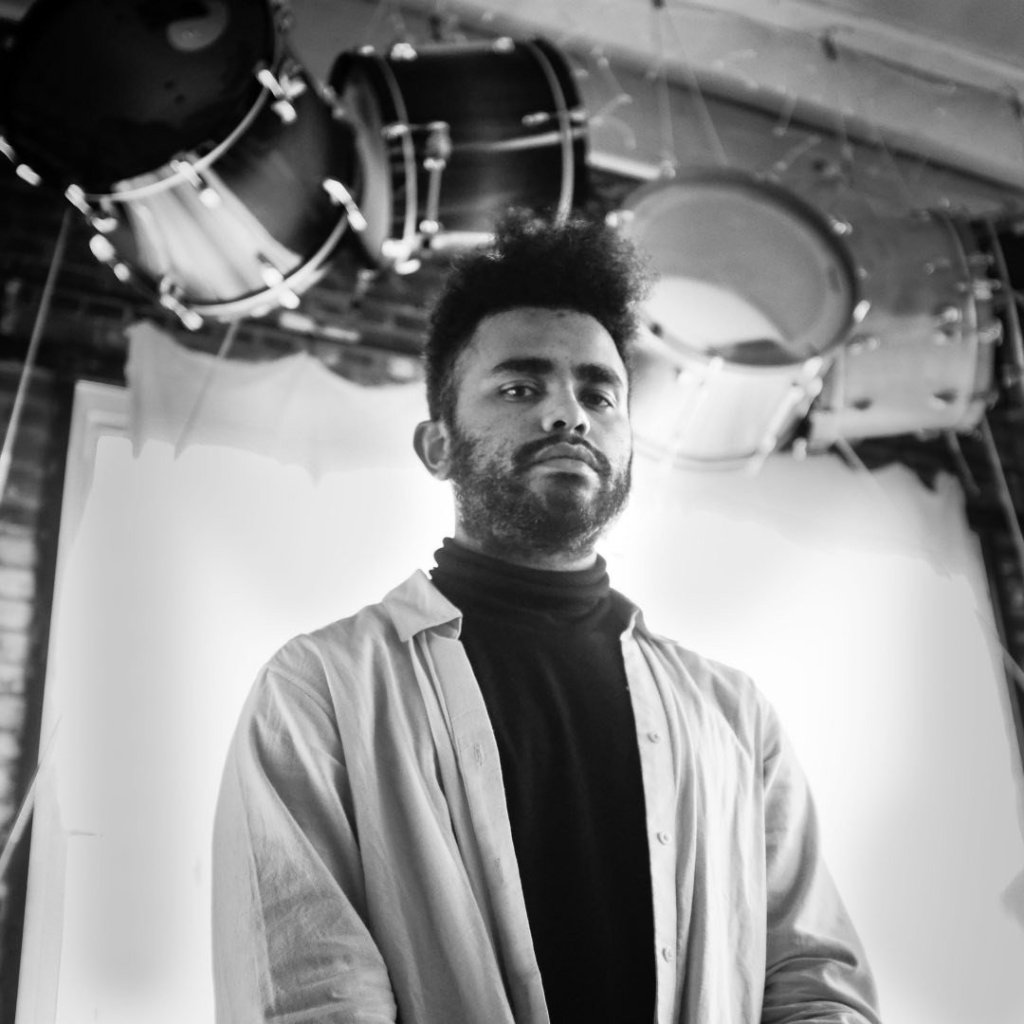
Nick Dunston – photo by Ernest Stuart

Nick Dunston is an acoustic and electroacoustic composer, improviser, and bassist. An “indispensable player on the New York avant-garde” (New York Times), his performances have also spanned a variety of venues and festivals across North America and Europe. He’s worked with artists such as Marc Ribot, Ches Smith, Mary Halvorson, Imani Uzuri, Ingrid Laubrock, Tyshawn Sorey, Anna Webber, Amirtha Kidambi, and Vijay Iyer. In addition to three studio albums released under his name, Dunston has also been commissioned by artists and ensembles such as Bang on a Can, JACK Quartet, Ex-Aequo, Bass Players for Black Composers, Johnny Gandelsman, T R O M P O, Maggie Cox, Joanna Mattrey, and Joy Guidry. In 2020 in collaboration with Dogbotic Labs, he co-created “Ear Re-training”, a music composition course on media-bending experimental techniques. He is currently Artist-in-Residence with Wet Ink Ensemble for the 2021-2022 season.

Jamie Elless

Jamie Elless (b.1998, they/she) is a composer, performer and graphic artist from the Midlands, currently based in London and Birmingham. She is a Gareth Neame scholar at Trinity Laban Conservatoire of Music and Dance, studying composition with Laura Bowler and Gwyn Pritchard and harpsichord with James Johnstone. Jamie completed her BA and MRes degrees in Music at the University of Nottingham, studying the latter as a Henry Thomas Mitchell scholar under the supervision of Elizabeth Kelly and Duncan MacLeod.

Jamie’s background as a self-taught folk musician (guitar, bouzouki, guzheng) is integral to her artistic voice, often drawing on worldwide indigenous musical and poetic traditions within her music and visual art. Jamie’s music has been performed by: YCP Birmingham (2014-16); 315 Ensemble (2017,2021); KOMPOSIT (2018); Villiers Quartet (2018); members of Royal Northern Sinfonia (2019); Weller Collective (2019); James Banner (2021); Duo Selva-Antongirolami (2021) and members of Britten Sinfonia (2021). She has taken part in masterclasses and workshops with: Xenia Pestova; David Liptak; Judith Weir; Joe Cutler; Dobrinka Tabakova; Gianpaolo Antongirolami; Michele Selva; James Banner; Tim Gill; and Deirdre McKay. Jamie won the Final Year Prize in Composition from the University of Nottingham in 2019 and the Bernard Slee Prize for Opera in 2021.

Pressmitteilung – DEUTSCH

Ich freue mich sehr, im Rahmen meines Call for Pieces-Projekts, das während der Pandemie begann, 3 neue Aufträge ankündigen zu können. Dank des GVL-Stipendiums kann ich Yaz Lancaster, Nick Dunston und Jamie Elless beauftragen, 3 neue Solostücke für Kontrabass zu kreieren, die online geworkshopt, gemeinsam entwickelt und im Frühjahr 2022 aufgeführt/aufgenommen werden. Da die Workshops per Videostream stattfinden, kontaktieren Sie mich bitte, um den Link zu erhalten.

Nachfolgend erfahren Sie mehr über die Komponist*innen:

Yaz Lancaster

Yaz Lancaster (they/them) ist ein Black transdisziplinärer Künstlerx, der sich am meisten für Praktiken interessiert, die mit relationaler Ästhetik und dem Alltag in Einklang stehen; Fragmente und Collage; und Befreiungspolitik. Yaz tritt als Geigerx, Sängerx und Steel Pannistx in einer Vielzahl von Umgebungen auf, von DIY- und Popmusik bis hin zu Orchestern, und their Arbeit wird in vielen verschiedenen Medien und Kooperationsprojekten präsentiert. Oft wird mit spezifischen Einflüssen gerechnet, die von Identitäts- und Befreiungspolitik bis hin zu Naturphänomenen und Poetik reichen. Yaz lebt in Lenapehoking (Harlem, NYC) und they haben Abschlüsse in Violine und Poesie an der New York University.

Nick Dunston – Foto von Ernest Stuart

Nick Dunston ist ein akustischer und elektroakustischer Komponist, Improvisator und Bassist. Als „unverzichtbarer Akteur der New Yorker Avantgarde“ (New York Times) haben seine Auftritte auch eine Vielzahl von Veranstaltungsorten und Festivals in Nordamerika und Europa überspannt. Er hat mit Künstlern wie Marc Ribot, Ches Smith, Mary Halvorson, Imani Uzuri, Ingrid Laubrock, Tyshawn Sorey, Anna Webber, Amirtha Kidambi und Vijay Iyer zusammengearbeitet. Neben drei unter seinem Namen veröffentlichten Studioalben wurde Dunston auch von Künstlern und Ensembles wie Bang on a Can, JACK Quartet, Ex-Aequo, Bass Players for Black Composers, Johnny Gandelsman, TROMPO, Maggie Cox, Joanna Mattrey, und Joy Guidry in Auftrag gegeben. Im Jahr 2020 war er in Zusammenarbeit mit Dogbotic Labs Mitbegründer von „Ear Re-training“, einem Musikkompositionskurs über experimentelle Techniken zur Medienkrümmung. Er ist derzeit Artist-in-Residence beim Wet Ink Ensemble für die Saison 2021-2022.

Jamie Elless

Jamie Elless (geb. 1998, they/sie) ist ein Komponistin, Performerin und Grafikerin aus den Midlands, der derzeit in London und Birmingham lebt. Sie ist Gareth-Neame-Stipendiatin am Trinity Laban Conservatoire of Music and Dance und studiert Komposition bei Laura Bowler und Gwyn Pritchard sowie Cembalo bei James Johnstone. Jamie absolvierte ihren BA- und MRes-Abschluss in Musik an der University of Nottingham und studierte letztere als Henry-Thomas-Mitchell-Stipendiatin unter der Anleitung von Elizabeth Kelly und Duncan MacLeod.

Jamies Hintergrund als autodidaktische Volksmusikerin (Gitarre, Bouzouki, Guzheng) ist ein wesentlicher Bestandteil ihrer künstlerischen Stimme, die sich in ihrer Musik und bildenden Kunst oft auf weltweite indigene musikalische und poetische Traditionen stützt. Jamies Musik wurde aufgeführt von: YCP Birmingham (2014-16); 315 Ensemble (2017,2021); KOMPOSIT (2018); Villiers-Quartett (2018); Mitglieder der Royal Northern Sinfonia (2019); Kollektiv Weller (2019); James Banner (2021); Duo Selva-Antongirolami (2021) und Mitglieder von Britten Sinfonia (2021). Sie hat an Meisterkursen und Workshops teilgenommen mit: Xenia Pestova; David Liptak; Judith Weir; Joe Cutler; Dobrinka Tabakova; Gianpaolo Antongirolami; Michele Selva; James Banner; Tim Kieme; und Deirdre McKay. Jamie gewann 2019 den Final Year Prize in Composition der University of Nottingham und 2021 den Bernard Slee Prize for Opera.

Thoughts on the collaborative process of Adopt A Composer

Having recently finished a relatively large-scale composition project on the Adopt A Composer Scheme, I thought I would write down some of my experiences, notes and advice to composers – what did I discover, what did I not predict, as well as what I might do do differently next time. This is meant for beginning composers like myself, but there might be something useful here for others too. A lot of the points are particularly relevant to writing for wind bands or working collaboratively with large leisure-time/amateur groups.

Communication

The communication was in general very good for this project, but there were still times where I could have allowed more time and been stronger in establishing certain things earlier on. For example, there was no bass trombone, one of the euphoniums is actually a baritone horn (and they read a Bb 9th transposition not bass clef), how many trumpet and oboe players there are officially on the band register vs. in reality, who is on leave, who is joining or not coming back. All of these things increased the likelihood of errors and also affected the way I composed at various stages, from conception through to finishing the parts. If I was going to do it again, I would collect the first name and instrument of everyone in the band along with a list of minimum and maximum personnel of the band right at the beginning of the project; I found as I went through the collaborative process I composed more and more for individual people or basing ideas on what specific people had said or comments they had made, so this would have been very helpful.

Taking Criticism

Some people are incredibly honest, others don’t feel comfortable expressing an opinion in front of others or face to face in private, some people don’t think anything! These are all valid. Nevertheless during this process there were moments where criticism was received (usually always in a well-meaning way) and I think this is a valuable experience for a composer, or for someone who works in a world where criticism is less forthcoming or expressed most often between close and established musical partners (in my case, the jazz and improvised music world). In this collaborative process it was also important to take on board that criticism and see what was at the root, this meant questioning the criticism, asking what a alternative idea would be etc. not taking it personally but being able to use it to change your thinking. Alongside this was trying to have a clear idea of what you want or what you mean, and being able to explain that face to face with other people. 90% of my previous experience has been as a sideman in an ensemble, as a performer, not composer, and in this role I am usually the one to receive these explanations from the band leader. This was another great learning experience that I can take forward not only into future commissions, but also into teaching and projects where I am the band leader.

Time and Visualisation/Imagination

People need time to get used to their parts and to new ideas, and as I was working with a new ensemble whom I didn’t know and who didn’t know me, I had to employ a greater deal of imagination and visualisation in terms of what I thought might be possible in the given time frame, how things might sound after 3 months of rehearsal, as well as try to predict what would work and what wouldn’t based on only hearing only fragments of material. This was compounded by the fact that in such a large band there are inevitably a certain number of absences each time. This is totally different to working with a smaller ensemble of people who know you, your approach and are able to fill in the gaps where you may only have a very rough idea e.g. in a small improvising jazz ensemble, or with a professional ensemble where members are paid or contracted to be there and getting to the stage hearing the actual written ideas performed may be a much quicker process. I would say that this has been the biggest learning experience for me and that the skill of hearing in advance is something incredibly valuable that can be trained most effectively by being in situations such as this.

Orchestration

I have found it invaluable over the last few years to study orchestration from books and scores, however my biggest learning curve was being in the room with the musicians and hearing the written music played. Having never written for such a large ensemble before, it was difficult to imagine whether certain notes would need more emphasis, how loud or quiet a certain dynamic was on a specific instrument or group of instruments, which instruments come through a texture, which need more support, whether certain rhythms when played by certain instruments are still clear etc. Having done this once, it will helpfully be easier the next time. 

I also discovered that people were often used to playing certain passages down (or up) the octave in order to make things easier to play, to fit on another instrument, or to keep stamina throughout a rehearsal. This obviously affects the sound of the music which may not be a big deal in some pieces in an ensemble’s regular repertoire, where voices are often doubled in other octaves, or in music that is largely tonal or based on full ensemble chords. The approach of this piece however often utilised smaller groupings of instruments, counterpoint, multiple tonalities, multiple melodies across the range of the band and less octave doubling than usual, so it was important to try to keep things at their original pitch. I found that I preferred to be notified of when this was happening so that I could actively change the part to be more playable, or move that person to another part, rather than it being passively changed during performance.

Notation

I created a notation guide within a wider set of performance notes in order to help the band (and any bands who may play the piece in the future) understand the written music. I studied some concert band scores and did research into notation conventions and found that there is often conflicting advice given, for example using dots or legato lines under slurs to indicate articulation. In the end the best thing I could do was decide for this specific piece what worked best and wasn’t too far away from the repertoire the band were used to, whilst at the same time what was the best representation and remained true to the ideas I was trying to convey. 

Layout

Part layout took way more time and effort than I expected! I had allowed around 2 weeks to work on it where I had a relatively free schedule asides from a few gigs/travelling. This was just about enough but I overestimated the amount of time I could spend working in this level of detail in any one day, which after between 6-8 hours with a break my brain reached capacity and I had to do something else. This obviously may be different for others. The main issue was that making one decision in one part can often affect what you do in another part, as you want everything to be relatively consistent. Another thing was I decided to rewrite a few sections of the music which took me away from the original task at hand. Specific to this project there was also the concept of…

Breathing

I found the only way to effectively conceptualise where to allow space for breathing or write breath marks was to individually sing each part – depending on the size of the ensemble this can take a lot of time. I know a lot of composers may not worry about this, or may not be writing in such a way that it requires a lot of thought, but for this particular project it was very important to allow for this; people who are not all professional musicians may have different tolerances for breathing and I had to take this into consideration.

Accidentals

Certain instrumentalists traditionally like reading either sharps or flats, both in the key signature (if there is one, there wasn’t in my piece) or within the music. Find this out at the beginning of your layout process, it took me some time… In general it’s best to write the accidentals as dictated by the harmonic context or what you wish you put across, but it’s also a good idea to triple check for visually strange/incorrect intervals like D# to Gb, followed by a perfect fourth down to C# etc. since they can make reading the music difficult.

Tutti/solo/divisi etc.

In the piece I have written, there are many changes between tutti, solo, divisi and uses of two people within a section. Given that everyone in a given section (e.g. Flute 1) reads the same part, it’s a good idea to check several times that you have reinstated the tutti marking after the solo, divisi, or two people only marking. A few missing markings might mean a lot of confusion and time wasted in the rehearsal! Also there is the fact that the performers need time  at some point to mark in their parts if they will be playing in the sections that require reduced instrumentation.

Dynamics

I discovered I have the habit of missing out dynamic markings on phrases that start after a bar or more rest, especially where there was a crescendo in that bar. How can the performer know for at which dynamic to re-enter at after 8 bars if there is nothing there? Sometimes it may be the same dynamic as before, other times different; I found it was better to repeat the marking for clarity.

Amalgamation of Scores

I composed most of the music on paper with pencil so it was quiet easy to mark in, for example, where a part divided, or which instruments I envisaged playing certain parts. However when it came down to create a computerised score and parts for real people to read, because I had non-traditional notation in the 3rd movement and instruments divided into separate roles of up to 5 soloists and tutti sections I had to create a separate score in Sibelius. Figuring out how to put the 3rd movement together with the others was a long process! There is then potentially the additional creation and combining of PDFs to consider.  

Use of Improvisation

I discovered that more (positive) limitations were effective in embedding improvisatory elements into the music. People felt more free to improvise and more confident if they had less options and more specific information to work with. 

Non-Musical Considerations

Can you line up your schedule and other work commitments with that of the ensemble? As I was finishing up the compositional process and since the band needed time to rehearse this piece and for upcoming concerts where they were playing other repertoire, we decided it was best to create a timeline of deadlines and when I would attend rehearsals etc. This gave me something to work towards and also meant that I was then free to try to work all my other commitments around these dates. Of course it helps it both parties have seem degree in flexibility too, since things can change last minute. 

Are you going to record and/or perform the piece? I was very lucky in that the process of doing a performance and recording is built into the Adopt A Composer Scheme, nevertheless there is still some element of providing information to several organisations of people well in advance, deciding on venues and dates, proving a text for the programme etc. All of these things take time and depending on the situation you may have to do all or some of it yourself – luckily I had a great team of organisers in the ensemble who helped with this at the various stages by going to meetings, seeing venues when I was unavailable etc. and for this I am ever grateful.

Things not to miss

  • Cue parts – an obvious cue that someone can see and hear at the same time so that they know when to come in
  • Breathing/breath marks
  • Using non-musical ideas/words to help describe the feeling of the music (especially when using improvisation with majority non-improvisors)
  • Legacy – how/are people in the future going to play this piece? Create some performance notes/explanations of anything unusual or different in your score and the inspiration behind it

Adopt A Composer

In September I was selected for Adopt A Composer, a scheme run by Making Music in conjunction with Sound and Music, PRS Foundation and BBC Radio 3. This means I’ll spend a year working with the Two Rivers Concert Band in Ilkley, collaborating to create a new composition which will be premièred on BBC Radio 3 in 2019. You can keep up to date on our progression together through the blog, the first two instalments of which are available below:

https://www.makingmusic.org.uk/news/first-thoughts-adopt-composer

https://www.makingmusic.org.uk/news/james-banner-adopt-composer